I was delighted to be invited back to Dundee to work with Hope and her colleagues at the RSPB, delivering an art workshop to folks who work to support others through addiction and recovery.
When I am preparing for a workshop, I consider who I will be working with, and what their experience, confidence, and attitudes to art might be. The aims of this workshop were to bring people together from all over Dundee, people who work with those suffering addiction, or alcoholism and those who are recovering and building their lives and their communities. The RSPB team are building a programme that gets people in recovery into nature, so that they can feel the benefits. This workshop was organised to find out what people in recovery need, what the RSPB can best do to support them and what barriers need to be considered. The RSPB team needed to have a conversation with the support workers from across the community.
This is where the art comes in.
Firstly, we wanted to demonstrate the kind of art workshop that could be part of the nature recovery programme. What service users could expect, as they spend time in nature, and are guided through creative ways to reflect. But secondly, and probably more importantly, the art workshop was to loosen everyone up, to get them feeling creative and relaxed and talkative, so that they could more easily converse with one another about what service users actually need.
My role, as an artist, was to ensure that everyone felt inspired and able to chat. I had no idea what experience with art the participants had, so it was much more important to deliver a workshop that was playful, rather than focused on any particular artistic outcome.
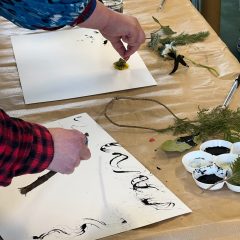
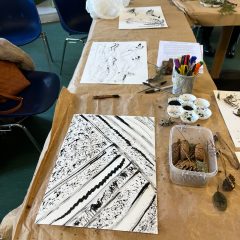
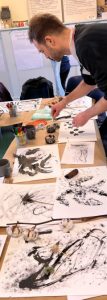
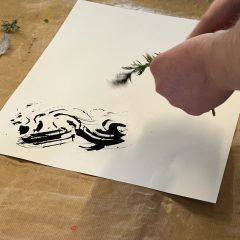
I first asked the participants to consider the objects they spotted as they explored the gardens of The Friary. The leaves, the twigs, the random pieces of nature. I asked them to bring back objects or photos. When they returned to the workshop space, I had rearranged the tables and brought out paper and inks. I first asked the participants to use their leaves, twigs and pinecones to draw, dipping them into the ink and experimenting with the marks they could make.
A task like this is a great leveller. It is fun, and silly, and creative, and impossible to get wrong because there is no concept of ‘right’. The participants jumped right in and started playing and mark-making, getting more and more creative with each twig and new sheet of paper. And importantly, they started talking to one another. A much more relaxed feeling descended over the room as we were united in play.
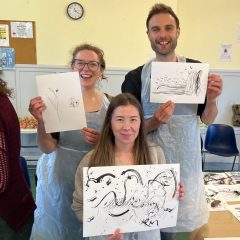
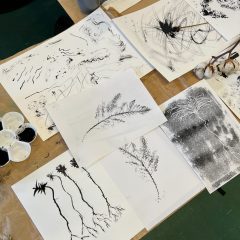
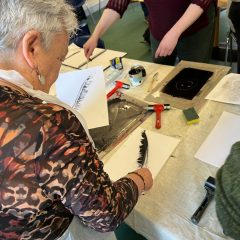
On a separate table, I set out printing inks on printing plates and demonstrated three different ways of monoprinting. Monoprinting is a technique that can be endlessly creative but it also benefits from the thrill of the reveal – that moment when you peel the paper back to see what ink and pressure has created. With very little instruction, and a lot of enthusiasm, the participants took turns in printing feathers, leaves and twigs, and printing lovely drawings by removing or scratching into the ink. I had the lovely job of standing back and watching the satisfaction and delight as participants revealed their creations.
We only had a short amount of time before I had to start tidy up. I washed up the dishes of ink, the rollers, the plates, and then came back into the main room where everyone was talking animatedly. The art had succeeded in making each participant come out of their shell, and they were busy sharing their experiences, talking about how they could make the best recovery programme possible, and sharing their knowledge and wisdom as the RSPB team listened and took notes.
Thank you to Hope for organising a great workshop, and to all the participants for their enthusiasm, creativity and wisdom.